THOUGHTS, WRITINGS, RECORDINGS
from our priests
Special Announcement
January 25, 2019
Special Announcement from the Office of the Lenker
Dear Friends,
With this letter I am happy to share with you that Rev. Craig Wiggins has been asked to carry the position of Lenker for the Christian Community in North America and that he has accepted.
Craig was born and raised in Missouri but spent much of his adult life in Europe. He was ordained in 1992, and worked for 18 years in various congregations in the Netherlands. He was then sent to the United States where he worked briefly in the Philadelphia area community before taking on the congregation in San Francisco.
This request came just as Craig was about to move to Chicago and become the community priest there. Gratefully, he has agreed to continue with this plan for the near future with the hope that an additional priest can be found to join him there soon.
Craig will assume regional responsibilities transitionally until this summer, at which point he will step into that role solely. The tasks of the regional Lenker in the Christian Community are to guide and support the work that happens at each altar, as well as to create a unifying consciousness within one region, bringing together the very different communities that we are.
Please join me in welcoming Craig into the task of holding a movement that wants to work with the presence of the Risen One in our earthly lives.
With warm greetings,
Oliver Steinrueck
North American Newsletter
Volume 26, No. 2, Advent, 2018
Please CLICK HERE to follow the link to the online PDF.

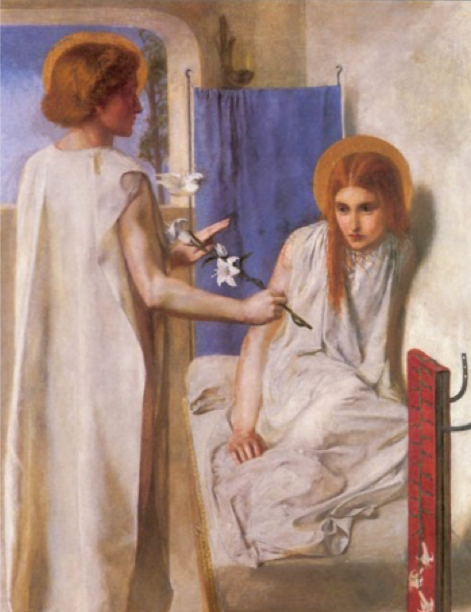
The Annunciation by Dante Gabriel Rossetti
THE WEEKLY WORD
THE WEEKLY WORD
Sermon on Paul's Letter to the Ephesians chapter 6
As the Christian year comes moves towards its culmination, we celebrate the festival of Michaelmas, in which we turn to the one who has so united himself with Jesus Christ that he shines out his countenance. He stands by us in all our trials and challenges of becoming truly, fully human.
Every day we encounter evil. It rises up in a multitude of forms, grasping every moment of human encounter, enters our thoughts, our hearts, our desires, and tries to lead us off the path, out of the full daylight of consciousness. As we wrestle to try to take hold of our unique selfhood, it adjusts to our personal pitfalls, and clothes itself in partial refections of what we think we want. Evil is clever, and dedicated!
Sermon on Paul's Letter to the Ephesians chapter 6
As the Christian year comes moves towards its culmination, we celebrate the festival of Michaelmas, in which we turn to the one who has so united himself with Jesus Christ that he shines out his countenance. He stands by us in all our trials and challenges of becoming truly, fully human.
Every day we encounter evil. It rises up in a multitude of forms, grasping every moment of human encounter, enters our thoughts, our hearts, our desires, and tries to lead us off the path, out of the full daylight of consciousness. As we wrestle to try to take hold of our unique selfhood, it adjusts to our personal pitfalls, and clothes itself in partial refections of what we think we want. Evil is clever, and dedicated!
The reading today from Paul’s letter recognizes that the human being is in a battle which is less an outer battle but one of the finest inner struggles. So he speaks of an armor that we can put on our in our soul life: standing firm, girding ourselves with truth, wearing the breastplate of moral alignment, and bringing the gospel of peace into our very walking through our days. Faith can serve as a shield; the healing that Christ brings can protect our thought life; and the word we choose to speak can act as a sword.
All of this is to protect the human heart—the organ of perception for the other, for God, and the guide for one’s own direction and deeds in life. The heart of the matter. The heart of the human being.
Yesterday we heard a wonderful quote: Patience eats the devil. Patience is a quality of soul that upends the entire effort of the Adversary to steal our lives from us. With the practice of patience, we refuse interference by the adversarial powers who would steal time away from the unfolding of our lives, our spirits into earthly existence. We need time to become. We need time to listen to another. We need time to help children grow up. We need time to understand. We need time to learn. And only with time does love arise, growing from a feeling into deeds. Christ is the Lord of Time, which is why he is also the Lord of Karma and Destiny. The devil and Satan would steal time from us. Patience is another practice of putting on the armor of God.
The Sacrament also unfolds in time. It is ordered with a clear beginning and end, and in between is a path of becoming which unfolds. The Sacrament is, in one of its aspects Time Medicine for human beings, restoring to us a sense of peace in the holy unfolding of spiritual light into earthly daylight. It is gives back to us a living moment, pregnant with the becoming of our spirit into our soul-bodily life. Without taking time for such events such as sacrament, prayer, thanksgiving, these do not demand our time. We can be so busy that we forget to tend to the most important things in our lives.
The working of evil is clever and economical; it capitalizes on our weak spots and most of the time, probably does not have to work so hard.
In the Christian classic, Thomas à Kempis’ Imitiation of Christ, there is a chapter entitled: On the Blessed Sacrament—Holy Communion Ought Not To Be Readily Deferred.
In this chapter, he says: “If you seek healing for your passions and habits, and desire to be made stronger and become more vigilant against the devil’s deceits and temptations, then you must have frequent recourse to the fountain of grace and divine mercy the fountain of goodness and all purity. Aware of the great fruit and healing power within the Sacrament, the enemy tries with all his might—in every way and at every opportunity—to hinder and prevent the faithful and devout person from receiving it.” He describes these attacks, and then goes on to say: “Pay no attention to the enemy’s wiles or to the images he instills in your minds—no matter how horrid or shameful they be—but hurl all phantasms back upon his head.”
“What advantage is there in delaying confession or putting off Holy Communion? Cleanse yourself immediately; spit out the poison and be quick to take the antidote and you will feel much better than if you kept delaying for a long time.”
What a gift we have to be able to commune with the one who would have us become truly who we are—all different from one another—and who does not fear this, or want to suppress it—but celebrates it, longs for it, and offers himself completely to us that it may become? What joy, what a holy gift that we have a God who loves us with his entire being, and offers to clothe us in the true armor of his love in every moment!
— Liza Marcato

Letter to the Congregation! Michaelmas 2018
Dear Community!
The Christian Community Movement for Religious Renewal Worldwide will be 96 this September 16. In four short years our centennial will arrive. How might we want to recognize and celebrate our 100th birthday? Join us on Sunday the 16th for this month’s special Members’ Meeting: a Community Potluck and Gathering to converse with one another about our 100th milestone and how we want to celebrate it at the local and North American regional levels, and with the wider world!
This Fall, Rev. Bastiaan Baan will offer a conference October 20-21: How Do We Know, Confront and Work with Evil? We expect a fair number of visitors from outside our congregation. If you would like to offer housing, you can let Liza know. You can register on our website to attend! Such events illustrate our wider mission as a center of spiritual life.
Dear Community!
The Christian Community Movement for Religious Renewal Worldwide will be 96 this September 16. In four short years our centennial will arrive. How might we want to recognize and celebrate our 100th birthday? Join us on Sunday the 16th for this month’s special Members’ Meeting: a Community Potluck and Gathering to converse with one another about our 100th milestone and how we want to celebrate it at the local and North American regional levels, and with the wider world!
This Fall, Rev. Bastiaan Baan will offer a conference October 20-21: How Do We Know, Confront and Work with Evil? We expect a fair number of visitors from outside our congregation. If you would like to offer housing, you can let Liza know. You can register on our website to attend! Such events illustrate our wider mission as a center of spiritual life.
We continue to carry the question of how we can strengthen our ability to be more welcoming within and beyond our congregation. We are putting the question of naming our church aside for now, but would like to invite more collaboration on weaving a welcome out of the things we stand for, the substance of our strengthening religious practice, and our highest intentions for the world as bearers of the gifts that come through the sacraments. Come participate in our Members’ Meetings to keep envisioning the life and growth of our congregation!
To begin our new Fall program, we have two speakers this September from the wider community: Gary Lamb, whom many know, on September 14, and Jon Rosen, a local (see his bio on our website’s calendar!), speaking on September 21. Details in the program!
New this Fall: two study groups offered by Hugh offering a deeper look at our liturgy and the Christian path. Liza will give two talks on the Beatitudes and the Sermon on the Mount. Please note a change in our weekly rhythm: The Wednesday 9am service will now take place on Thursday mornings at 9am. This change is inspired by Camphill Copake needing to move their weekly service from Thursdays to Wednesdays. The Act of Consecration will still take place on the Wednesdays on which there is a study group.
If you have a child entering 7th or 8th grade, we offer preparation towards receiving the Sacrament of Confirmation. Contact us for more information!
We intend to begin September 23.
Wishing you a fruitful autumn harvest,
Your Priests,
Liza Joy Marcato and Hugh Thornton
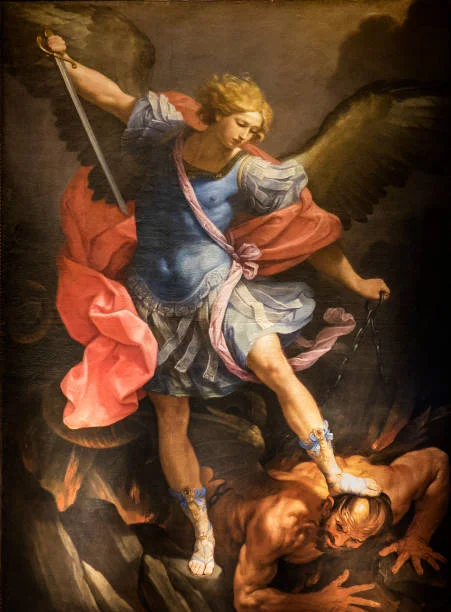
Michaelmas
The modern individual is able to meet another person and see through to his or her essential presence as an individual human spirit. To do this the various other ‘lesser bodies’ are momentarily disregarded, such as the person’s race, sex, nationality, language, religion, class, political affiliation and profession. To be able to behold the other, one has to momentarily renounce the otherwise continuous experience of self-feeling. This experience of feeling oneself as a self has grown both in its magnitude and intensity. It thus becomes increasingly resistant to the necessary renunciation for the purpose of receiving the revelation of another’s individuality.
The intensity of the experience of feeling oneself as a self has the side effect of promoting a disregard towards all the ‘lesser bodies.’ We’ve all probably heard someone claim how they are not an American, (or some other nationality) but rather ‘a citizen of the world.’ In this sentiment is expressed a reluctance to identify with one’s nationality. It is a tendency of the individual human spirit to be reluctant or to outright reject identifying with any one of the lesser bodies.
The modern individual is able to meet another person and see through to his or her essential presence as an individual human spirit. To do this the various other ‘lesser bodies’ are momentarily disregarded, such as the person’s race, sex, nationality, language, religion, class, political affiliation and profession. To be able to behold the other, one has to momentarily renounce the otherwise continuous experience of self-feeling. This experience of feeling oneself as a self has grown both in its magnitude and intensity. It thus becomes increasingly resistant to the necessary renunciation for the purpose of receiving the revelation of another’s individuality.
The intensity of the experience of feeling oneself as a self has the side effect of promoting a disregard towards all the ‘lesser bodies.’ We’ve all probably heard someone claim how they are not an American, (or some other nationality) but rather ‘a citizen of the world.’ In this sentiment is expressed a reluctance to identify with one’s nationality. It is a tendency of the individual human spirit to be reluctant or to outright reject identifying with any one of the lesser bodies.
Along with this rejection comes the tendency to hyper-identify with this or that lesser body. Nationalism is a familiar case; the essence, however, is not restricted to national identity. Hyper-identity results when an individual identifies with one of her lesser bodies, and to such an extent that she experiences her identity as existentially inseparable from that lesser body. In such a case that body is no longer experienced as an instrument of the individual but as indistinguishable from it.
Nothing more effectively cements the individual human spirit to one of the lesser bodies than fear. Storms of thought-phantoms are let loose into the world with the explicit intention to polarize people into factions of ‘hyper-group-identity.’ These groups then become charged against their opposites. Conflict between the groups becomes as inevitable as the natural laws governing magnets. In such a state of hyper-identity as we witness presently in political groups, individuals lose their ability to gain perspective above the prevailing thoughts which define their political bodies, their political selves.
In this situation we are in need of Michael’s gaze, which would help us crack the cement of fear imprisoning us within any lesser body of identity. We need his gaze to see through to the essential human spirit of the person we would otherwise condemn as ‘wrong.’
Michael’s way does not seek to sever us from our ‘lesser bodies’ but rather to honor, respect, and bare the burden of responsibility inherent in the bodies given to us from birth and during the course of our upbringing — and those we choose as adults. He leads us to understand the mystery of the name.
“Those who did receive him were able to reveal themselves, through him, as children of God; those trusting in his name who: not of blood, nor of the will of flesh, nor of human will but are born of God.”
Through this verse from the Prologue of the Gospel of John we encounter the mystery of the name. Contained in one’s name are most of the essential elements of how we manifest in the world through the sheaths of all the lesser bodies: race, sex, family, language, culture, nation, religion. The elements that in the Prologue are described as: blood, the will of flesh and human will. These are the ephemeral, mortal aspects of our existence and compose the human personality in all of its various ingredients. To the extent to which a human spirit individualizes the personality is the extent to which the immortal spiritual self is revealed in the world through the name.
We are all known by our names. In the course of our lives our names take on new meaning through our work in the world. Michael, champion of the human spirit’s name, guards us from devaluing ourselves on the scales of the lesser bodies.
Hugh Thornton
Letter to Our Community • Easter 2018
Dear Community!
Theme for Holy Week and Preparation for Easter
This year our theme is ‘Walking with the Risen One.’ We’ll explore his achievement of overcoming the polarities of the created world in sermons & daily conversations after the service.
Starting Holy Saturday, March 31st, from 6:00—6:30pm, we’ll begin a new monthly Close of Day ritual devoted to the community of those who have crossed the threshold of death. From the pulpit, within the context of the sermon, the names of those who died in the month that follows will be named, that we may better accompany those across the threshold, and live in stronger connection with them.
Dear Community!
Theme for Holy Week and Preparation for Easter
This year our theme is ‘Walking with the Risen One.’ We’ll explore his achievement of overcoming the polarities of the created world in sermons & daily conversations after the service.
Close of Day Announcements
Every Tuesday evening from 6:30–7:30pm, we gather at the altar to celebrate one of the special rituals of The Christian Community Movement For Religious Renewal, namely, The Close of Day. We are currently looking at some of the letters—John, Paul, and others, and on Tuesday April 10th, we will begin a new journey through the entire book of The Book of Revelation to John. Each evening there is a reading and a sermon, followed by a conversation. The ritual lasts about a half an hour; the conversation the same. We are looking for interested musicians who would like to play music for the beginning and end, please contact Hugh or Liza!
NEW! Starting Holy Saturday, March 31st, from 6:00—6:30pm, we’ll begin a new monthly Close of Day ritual devoted to the community of those who have crossed the threshold of death. From the pulpit, within the context of the sermon, the names of those who died in the month that follows will be named, that we may better accompany those across the threshold, and live in stronger connection with them.
The Blessings of our Community’s Elders on April 29
We stand upon the shoulders of those who come before us. Our community has been lovingly built up and carried by many dedicated individuals. Join us as we sit together in the living room and celebrate the “elders” in our community. Enjoy refreshments, and listen to our elders as they share their good wishes, and bestow their blessings on the younger generations! Bring your children and yourselves for this special event.
Thirteen Days of Ascension and Whitsun, May 10–22
Join us again this year for our daily celebrations of The Act of Consecration during Ascension and Whitsun.
Wishing you a transformative Passion, Easter, Ascension and Whitsun season!
Your priests,
Liza Joy Marcato and Hugh Thornton
True Sacrifice
Passiontide
Who built the cathedrals of Europe? No one knows, and that is the point. They were built anonymously. Their work was an expression of the builders’ religious practice. To have it recognized would have offended the intention of their devotion.
Sacrifice remains essential to religious practice in general and for The Act of Consecration in particular. The word ‘sacrifice’ is often used outside the context of religious practice. We can grasp its religious meaning through comparison with its commonplace usage.
Who built the cathedrals of Europe? No one knows, and that is the point. They were built anonymously. Their work was an expression of the builders’ religious practice. To have it recognized would have offended the intention of their devotion.
Sacrifice remains essential to religious practice in general and for The Act of Consecration in particular. The word ‘sacrifice’ is often used outside the context of religious practice. We can grasp its religious meaning through comparison with its commonplace usage.
When we make a decision there follow the consequences of that decision some of which may not always be so pleasant. Others may make a decision and we may suffer as a result of the consequences that follow. Here we have to reckon with something that is common in life, namely, disappointment. Disappointment arises when our wishes remain unfulfilled. Continuing to want something that the soul cannot have leads to the soul’s illness. Conversely, wanting that which can be attained leads to the soul’s thriving when it is attained. Disappointment gets confused with sacrifice.
The practice of sacrifice occurs in the realm of the soul that is under the guidance of the human spirit. It is something that the spirit wills to do and wields the forces of the soul to accomplish it. The soul must first grow weary, to some extent, of the lesser pleasures of life before it has matured enough to rejoice in the greater joys of life. Therefore, with the practice of sacrifice there may come a bitter taste for the soul, at first, before it has developed a real taste for it. In time it will long for it and require it daily.
Perhaps the practice of sacrifice that The Act of Consecration asks us to make doesn’t seem like much, or that it amounts to much, or perhaps we have the question as to what it even is? We are being addressed by The Act of Consecration of Man as individual human spirits to approach the triune nature of our own souls and to turn our willing towards the Father God, unite our feeling with Christ and aspire to root our thinking in the life of the Holy Spirit. This is accomplished, simply enough at first, by devoting our attention during that hour before the altar.
When we practice sacrifice we are absolutely getting exactly what we want, for it is the art of a highly intentional wanting. When we’re not getting something we want or when we think that we’re ‘giving up’ getting something we want we aren’t practicing sacrifice. If we call this sacrifice we do so in vain.
When sacrifice also includes a renunciation a further step has been made whereby the benefit of the practice of sacrifice is foregone and instead made available as a gift for others and the world. Another word for sacrifice is gift.
The divine blessing that streams into the world through the sacraments may be received by all. Through them a revolution is incited which conquers the world with gentleness and would transform it thoroughly. All that is received will be of great benefit for the one who receives it— in ways difficult to conceive or to imagine to what magnitude. There will come a time of decision for each one when life asks, “What will you do with the gifts which you have received?” For all that we receive is of such a nature that we can only ‘keep’ it for ourselves in the act of giving it away to others and to the world. Were we to attempt to keep it for ourselves it would gradually transform, in the condition of its self containment, into its opposite. “…Lilies that fester, smell far worse than weeds…”
We overcome the ways of the world when we become givers and in giving have ever more to give.
Hugh Thornton